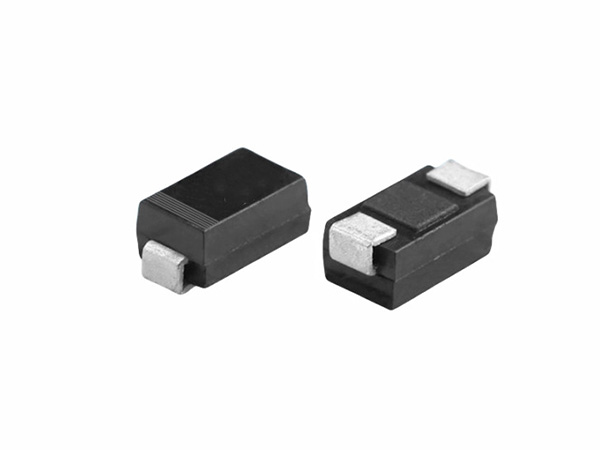
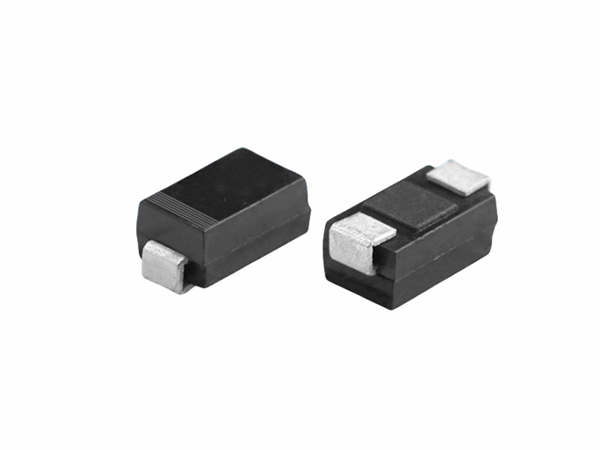
Transient suppression diode, also known as TVS diode or transient suppression diode, is a widely used new type of high-efficiency circuit protection device. It has extremely fast response time (sub nanosecond level) and considerable surge absorption capability. When its two ends are subjected to a momentary high-energy impact, the TVS tube can quickly change the impedance value between the two ends from high impedance to low impedance, absorbing a momentary high current and clamping the voltage at both ends to a predetermined value, thereby protecting the subsequent circuit components from the impact of transient high voltage spikes. Therefore, TVS transient suppression diodes can be used to protect devices or circuits from transient voltages generated by static electricity, inductive load switching, and overvoltage caused by induced lightning
10 considerations to take into account when choosing TVS:
(1) Evaluate the usage environment. If the TVS diode needs to withstand surge voltage (spike pulse voltage) from two directions, use a bidirectional TVS diode. Otherwise, choose a unipolar unidirectional TVS device
(2) The Vc value of the TVS diode should be lower than the maximum voltage of the protected component. Vc is the voltage value of the diode in the off state, which is the voltage passing through the TVS during ESD surge state. It should be noted that Vc cannot exceed the maximum voltage that the protected circuit can withstand, otherwise the protected device is at risk of being damaged
(3) Under normal working conditions, the TVS diode should not be in a breakdown state when it is below VR
(4) If the surge current IPP is determined, the power can be determined through VCIp. If the approximate range of IPP cannot be determined, choose TVS diodes with higher power. At a given maximum clamping voltage, the greater the power consumption PM, the greater its ability to withstand surge currents; At a given power consumption PM, the lower the clamping voltage VC, the greater its ability to withstand surge currents. In addition, peak pulse power consumption is also related to pulse waveform, duration, and ambient temperature
(5) The transient pulses that TVS diodes can withstand are non repetitive, and the specified pulse repetition frequency (duration to interval time ratio) of the device is 0.01%. If there are repetitive pulses in the circuit, the accumulation of pulse power should be considered, otherwise it may damage the TVS
(6) When protecting low current loads, a current limiting resistor can be added to the circuit. As long as the resistance of the current limiting resistor is appropriate, it generally will not affect the normal operation of the circuit
(7) The capacitance of a TVS diode is measured at a specific frequency of 1MHz and is determined by the avalanche junction cross-section of the TVS. Due to the fact that the size of this capacitance is directly proportional to the current carrying capacity of the TVS, if it is too large, it will cause signal attenuation. Therefore, capacitance (C value) is an important parameter for selecting TVS in data interface circuits. In the high-frequency circuit of communication systems, the junction capacitance of TVS diodes has a significant impact on the circuit, which can easily cause significant noise or attenuation. Therefore, the junction capacitance of TVS diodes used in high-frequency circuits should be as small as possible, Do not exceed 3pF
(8) According to the IEC61000-4-2 international standard, TVS diodes are required to withstand ESD shocks higher than 8KV (MB, contact) and 15kV (BM, air). In the quality conscious and fiercely competitive market, some semiconductor manufacturers have adopted higher-level impact resistance standards for their products
(9) When selecting based on parameters, a certain margin should be left to avoid devices operating near the design parameter limits. As long as the price allows, it is advisable to choose devices with fast response speed and high sensitivity to effectively protect the device
(10) In practical applications, TVS diodes can be combined with other circuit protection devices, or composite devices that integrate other functions can be selected to cope with harsh and changing usage environments
Jiangsu Daqi Semiconductor Technology Co., Ltd. © Copyright 2025
【Backstage】