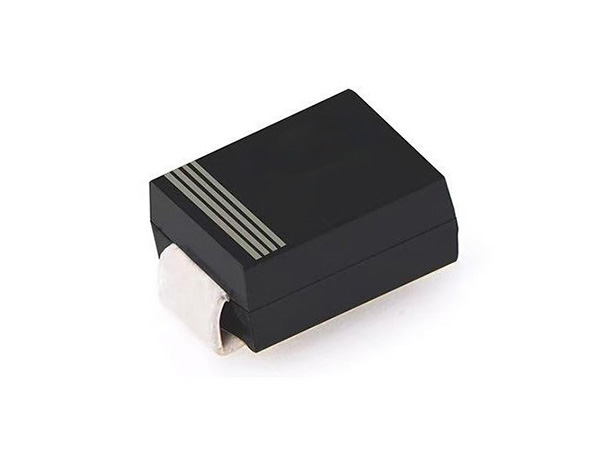
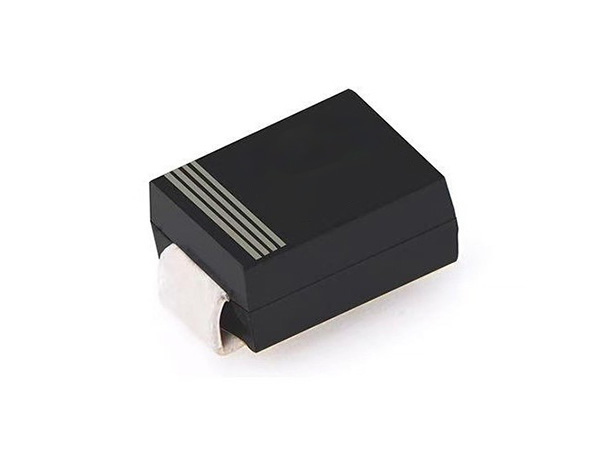
The circuit symbols and packaging of voltage regulator diodes and TVS diodes are basically the same as those of voltage regulator diodes, and sometimes it is even difficult to distinguish them in appearance. How can we distinguish between using voltage regulators and TVS transistors
1. Circuit connection method
Zener diodes and TVS diodes are both connected in reverse in the circuit, which utilizes their reverse characteristics and PN junction avalanche effect to have a critical voltage before reverse breakdown. They both have a stabilizing effect in reverse connected circuits, but they are not the same. Zener diodes use to fix the input voltage at a certain value, while TVS diodes mainly prevent transient high voltage from clamping the downstream circuit
2. Response time
Zener diodes generally do not talk about response time, but focus more on the voltage regulation value. However, for TVS diodes, their characteristics determine that they have different functions. TVS diodes have transient suppression high-energy effects, so it is required to absorb higher energy in a short time, reaching the nanosecond level
3. Power size
The power of a voltage regulator diode is generally not very high. Common voltage regulators include 1W, 2W, etc. Its power is determined by the temperature rise it allows. In fact, it is the product of the stable voltage and current. For example, for a voltage regulator diode 1N4742A, its maximum power is only 1W, and the voltage regulator value is 12V. Therefore, the current passing through it generally cannot exceed 80mA, otherwise the tube will heat up severely; For TVS diodes, the emphasis is on instantaneous pulse power, which is very high and can reach over kilowatts, but the time value is kept very small
Zener diode
Zener diode is a type of diode that utilizes a PN junction to maintain a relatively constant reverse breakdown voltage, but the current can vary within a certain range. Zener diode has a high resistance state before the reverse breakdown voltage, and beyond this critical point, it is in a low resistance state. Zener diodes are widely used in various voltage regulation circuits, voltage reference components, and other applications. They can be used in series to achieve higher voltage regul ation values
Zener diodes are commonly referred to as "ZD" in circuits. The main parameters of Zener diodes include: voltage regulation value, dissipated power, and maximum operating current. When designing circuits, these three factors should be fully considered. As shown in the figure below, there is a resistive capacitive buck circuit with a voltage output of 12V. A 1N4742A Zener diode is used, which has a voltage regulation value of 12V and a power of 1W
TVS diode
TVS tube is a transient suppression diode, a semiconductor device with surge absorption capability. Its response time is extremely fast, reaching sub nanosecond level. Therefore, once the circuit receives an instantaneous high-energy impact, it can suppress this energy and absorb the instantaneous high current and high voltage clamp from the circuit, ultimately protecting the equipment or circuit behind it
TVS diodes can be divided into unidirectional and bidirectional types. Unidirectional diodes are mostly used in DC circuits, while bidirectional diodes are mostly used in AC circuits. They are connected in parallel with the protected circuit in the circuit. Once the instantaneous voltage exceeds the normal operating voltage of the circuit, the TVS diode will experience avalanche effect, providing an ultra-low resistance path for the instantaneous current, thereby preventing damage to the protected device or equipment. Therefore, this TVS diode is highly suitable for ESD sensitive circuits and overvoltage circuits. As shown in the figure below, the polarity of the unidirectional TVS tube connected to the circuit should be opposite to the polarity of the power input in order for the circuit to function
Jiangsu Daqi Semiconductor Technology Co., Ltd. © Copyright 2025
【Backstage】