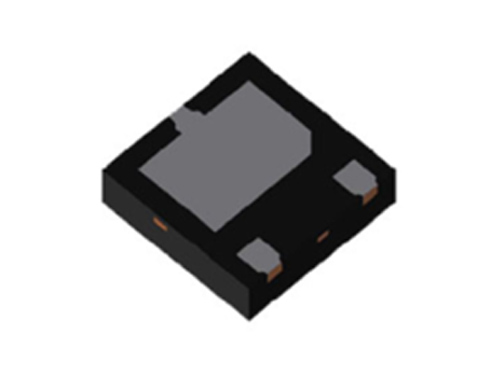
Many engineers, when selecting components, first look at the device's specified ESD rating — for example, "withstands ±15kV air discharge" — assuming that a higher value means better protection. However, in practical applications, failures often occur: even when using an ESD diode with a supposedly high rating, the device still gets punctured by surges in the field, and the chip burns out as well.
The key issue is that the ESD voltage rating is only one dimension, not a universal indicator. It shows the device's tolerance under standard ESD testing, but does not represent its clamping performance, surge current capability, or compatibility with high-speed signals. For instance, some ESD diodes may have a high ESD withstand voltage, but their "clamping voltage" after turn‑on is too high, meaning the protected chip can still be damaged by residual voltage spikes. In other cases, the parasitic capacitance of the device is too large at high frequencies, causing a USB 3.0 interface to run at only USB 2.0 speeds.
When selecting an ESD diode, several key parameters should be considered together: first, the clamping voltage should be as low as possible; second, choose a matching junction capacitance based on the signal rate of the interface; third, for applications with high exposure to external disturbances, consider surge current capability and repetitive ESD robustness. If your application environment involves lightning strikes or power surges, you also need a TVS diode at the front end for tiered protection — relying on a single ESD diode alone is often insufficient.
Jiangsu Daqi Semiconductor Technology Co., Ltd. © Copyright 2025
【Backstage】