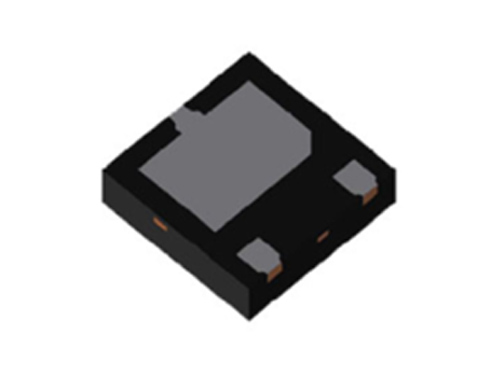
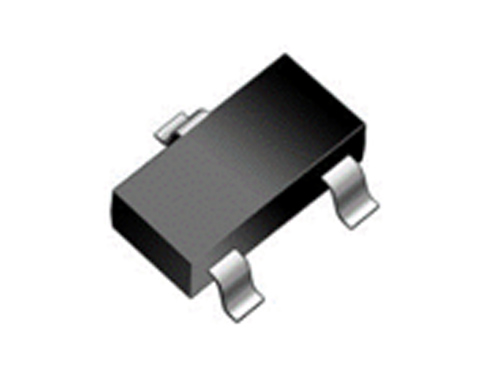
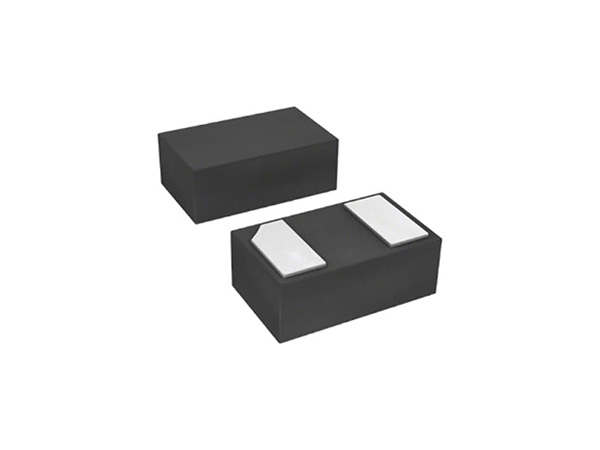
Many engineers, when selecting components, first look at the device's specified ESD rating — for example, "withstands ±15kV air discharge" — assuming that a higher value means better protection. However, in practical applications, failures often occur: even when using an ESD diode with a supposedly high rating, the device still gets punctured by surges in the field, and the chip burns out as well.The key issue is that the ESD voltage rating is only one dimension, not a universal indicator. It shows the device's tolerance under standard ESD testing, but does not represent its clamping performance, surge current capability, or compatibility with high-speed signals. For instance, some ESD diodes may have a high ESD withstand voltage, but their "clamping voltage" after turn‑on is too high, meaning the protected chip can still be damaged by residual voltage spikes. In other cases, the parasitic capacitance of the device is too large at high frequencies, causing a USB 3.0 interface to run at only USB 2.0 speeds.
Electrostatic discharge is actually everywhere. When a person walks in a dry environment, their body can accumulate several thousand volts of static electricity. When you plug or unplug a USB interface or touch a device button, these static charges are instantly discharged onto the circuit board. One such small pulse may not kill the device on the spot, but if repeated hundreds or thousands of times, the tiny internal structures of the chip will be gradually damaged, eventually leading to degraded performance or complete failure.So how can you tell if the ESD protection is the problem? Watch for these signs: product repair returns are concentrated on interface‑related failures; the failure rate of the same model increases significantly during dry seasons (autumn and winter); or the returned chips show obvious "breakdown points". If your product frequently experiences these issues, it is very likely that the ESD protection selection is inadequate.
TVS (Transient Voltage Suppression) is a voltage limiting protection device that functions similarly to a varistor. It also utilizes the nonlinear characteristics of the device to clamp overvoltage to a lower voltage value to protect the downstream circuit. The tolerance is expressed in watts (W). Based on the excellent characteristics of TVS tubes, bidirectional TVS is suitable for AC circuits and can absorb high-power pulses that occur instantaneously in both positive and negative directions.
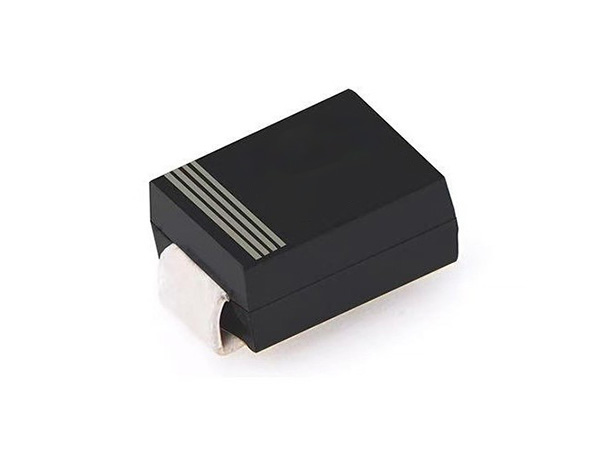
Transient voltage suppressor, abbreviated as TVS, is a high-efficiency protective device in the form of a diode. When the TVS diode is subjected to transient high-energy impact, it can quickly respond (in the order of P seconds) to transform the high impedance between its two poles into low impedance, absorb surge power of up to several kilowatts, stabilize the voltage between the two poles at a safe value,
As is well known, diodes have the characteristic of unidirectional conduction and can be applied in these fields: 1. Rectifying diodes are mainly used in rectification circuits, that is, pulsating rectifying diodes that convert alternating current into direct current are surface junction type, so their junction capacitance is large, which makes their operating frequency lower, generally less than 3Hz. 2. Under the action of DC voltage, the diode resistance of the switch is small and it is in a conducting state,
ESD (electrostatic discharge) protector is a device specifically designed to prevent damage to electronic equipment caused by electrostatic discharge. The following is a detailed explanation of ESD protector: 1. Definition and Function ESD protector is an overvoltage and anti-static protective component, whose main function is to transfer ESD stress from sensitive components, allowing current to flow through the protective component rather than the sensitive component